
Executive Summary
The Mandate
Europe stands at a razor-sharp crossroads. Trapped between the hyper-subsidised tech dominance of the US and the vertically integrated supply chains of China, the continent is at risk of becoming a mere consumer, rather than a creator, of the next industrial age. The era of bureaucratic consensus is giving way to speed. The emergence of the E6 Coalition (Germany, France, Italy, Spain, Poland, and the Netherlands) represents 70% of the EU’s economic weight, moving as a vanguard to fast-track economic and industrial sovereignty.
True sovereignty cannot be legislated from a tower in Brussels or Berlin. It is built in the labs, cleanrooms, and data centres of Europe's frontier technology SMEs.
What the E6 is Changing Right Now
The Capital Push
The finance ministers of France, Germany, Italy, the Netherlands, Poland, and Spain, the E6, are now speaking with a single, coordinated voice on European capital market reform. In a joint position paper addressed to the Cypriot Council Presidency and Commissioner Maria Luís Albuquerque, dated 28 May 2026, they identified six key priority areas to advance negotiations on the Market Integration and Supervision Package (MISP), the legislative cornerstone of the EU's Savings and Investments Union (SIU).
The SIU rebrands the long-stalled Capital Markets Union (first launched in 2015) around a sharper purpose: mobilising European household savings into productive, long-term investment. The urgency is structural; EU stock market capitalisation stands at just 73% of GDP, against 270% in the United States. MISP, spanning a Master Regulation, Master Directive, and new Settlement Finality Regulation, is the legislative vehicle designed to close that gap.
-
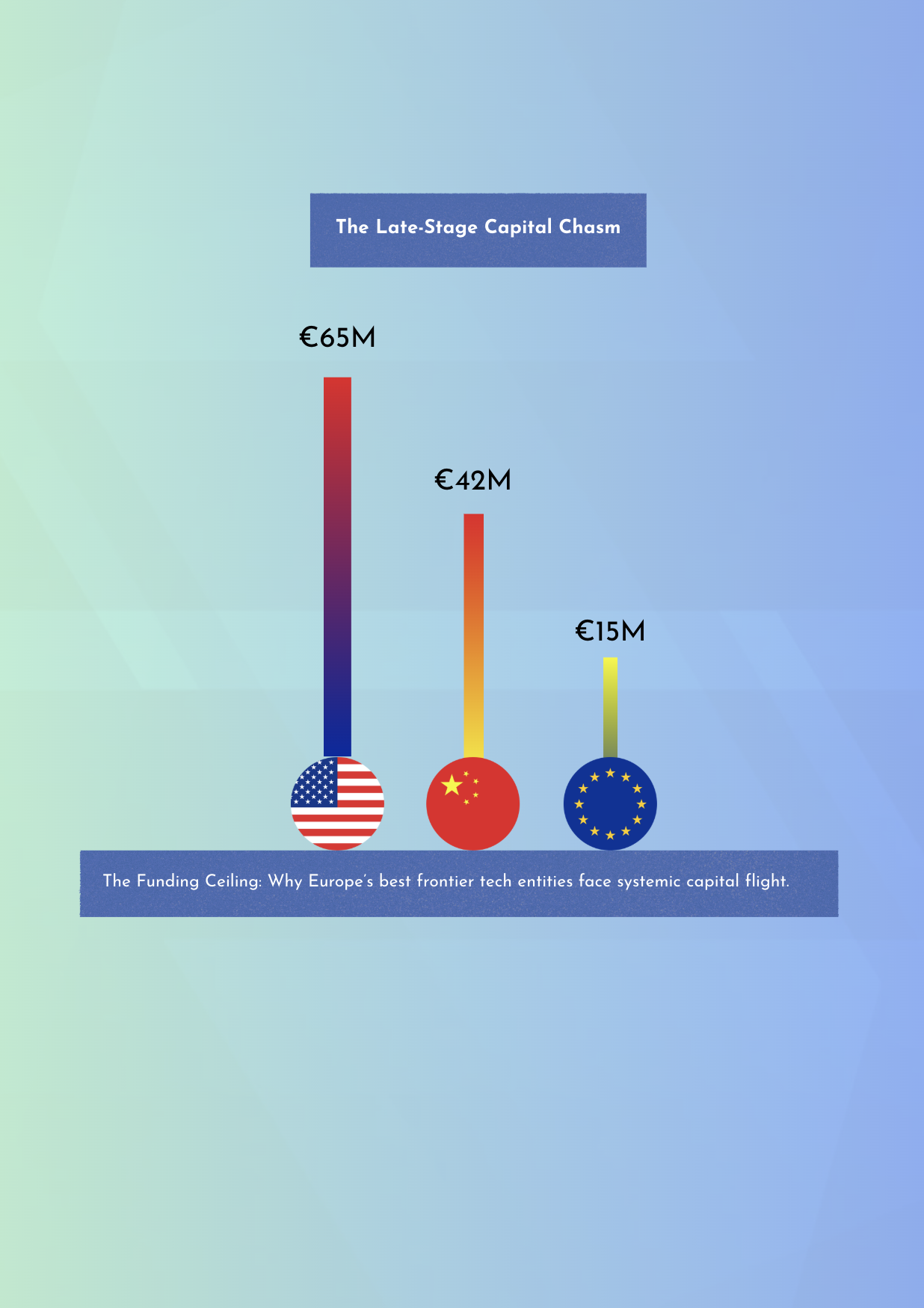
Europe's most acute structural problem is the shortage of capital available to high-growth companies seeking to raise over €100 million in late-stage development, forcing them to seek funding outside the bloc. The FIVE Initiative addresses this directly through a fund-of-funds mechanism channelling public and private capital into this neglected segment, building on the pan-European Scale-up Initiative backed by the EIB Group with an initial €500 million commitment.
-
Financial institutions currently face divergent requirements and supervisory practices across Member States that actively obstruct cross-border operations. MISP consolidates trading and post-trade infrastructure rules, rationalises asset management requirements, and expands ESMA's direct supervisory mandate. The E6's willingness to accept an enhanced ESMA role, provided the transition is well-structured, is a significant political signal.
-
Alongside capital markets reform, the E6 framework intersects with the EU's industrial sovereignty agenda, including the Chips Act 2.0 and Cloud & AI Development Acts designed to keep critical technology infrastructure, from semiconductor fabrication to AI compute, within European borders.
The Blindspot?
What the E6 framework gets right in ambition, it misses in grounding. MISP and the SIU are constructed almost entirely from the top down, shaped by finance ministers and Brussels-level regulators whose primary reference point is systemic stability and macroprudential oversight.
The operators actually working at the frontier of Quantum computing, Defense Tech, and Advanced AI, the mid-market firms and dual-use integrators that European strategic autonomy depends on, have no structured seat at the table where these frameworks are written. The FIVE Initiative addresses the financing gap in aggregate terms but does not differentiate between a SaaS company and a quantum hardware developer whose capital cycles, regulatory exposure, and supply chain dependencies are categorically different. The result: a policy architecture coherent at the macro level and increasingly misaligned at the operational one broad enough to pass through Council, but not precise enough to move capital where Europe most urgently needs it.
The Vulnerability: Capital & IP Flight Crisis
| E6 Policy Focus (Top-Down) | The Frontier SME Gap (Bottom-Up) | |
| Focuses heavily on banking liquidity, ESMA regulations, and raw materials procurement. | Lacks direct, practical input from mid-market operators handling Quantum, Defense, and Advanced AI. | |
| Prioritizes top-down scale-up financing frameworks (like the FIVE Initiative). | Often fails to reach the agile builders on the ground due to fragmented cross-border friction. |
The Reality
Europe does not have an invention problem. It has a capital architecture problem.
The science is world-class. The seed and Series A markets function. But somewhere between Series B and IPO, value migrates reliably, structurally, and at scale. The data is unambiguous: 70% of late-stage funding for European deep tech comes from outside Europe, predominantly the United States. For rounds exceeding $15 million, only 54% of capital is European-sourced, against 80% in the equivalent American market. More than 80% of European deep tech exits are acquisitions, with US buyers capturing the majority of that value. Just 6% of global VC funding for AI chips and processors went to Europe between 2022 and 2025.
The consequence is not merely financial. When a European quantum hardware company or defence-adjacent AI firm accepts growth capital from a non-European lead investor, board representation, IP licensing terms, and exit optionality all follow the money. As ESPI's analysis of European space rounds confirms, lead investors shape "more than funding totals, including board representation and voting rights" sensitive issues as Europe seeks sovereignty in increasingly strategic domains. The EIB is equally direct: EU scale-ups listed or acquired abroad "weakens the flywheel effect," draining the entrepreneurial capital and talent that would seed the next generation of European champions.
This is a national security problem, not merely an exit problem. McKinsey estimates Europe's deep tech engine could generate $1 trillion in enterprise value and one million jobs by 2030, but whether that value stays in Europe depends on building a credible growth-stage capital stack before the window closes. The Commission's own January 2026 study on Drivers of Relocation by Innovative EU Startups and Scaleups confirmed what practitioners have known for years: founders are not leaving by preference. The domestic capital market gives them no viable alternative at scale.
Fluid Capital, Borderless Innovation Securing the Full Orbit
The momentum behind the E6 Concord is a vital catalyst for the entire continent. Yet, the true metric of success for the Savings and Investments Union (SIU) will be its ability to distribute liquidity to where innovation actually happens. Industrial sovereignty cannot be achieved by concentrating financing infrastructure; it requires a borderless pipeline that feeds Europe’s entire frontier tech ecosystem.
Europe's orbit nations are not bystanders in this transformation; they are essential pillars. The unique ecosystem advantages developed in Dublin, Luxembourg, Lisbon, and Tallinn are vital to continental competitiveness. Any new late-stage financing instruments or streamlined regulatory frameworks built by the E6 vanguard must include deliberate, built-in access provisions for these high-growth regions from day one.
Initiative frameworks like the EQT-managed €5 billion Scaleup Europe Fund, set for its first close by autumn 2026, prove that cross-border capital alignment is achievable. But to truly insulate European IP from global buyouts, this logic must be formalised across all SIU policy levers. By ensuring the E6 engine powers the entire European orbit, we turn the risk of regional capital concentration into an unprecedented opportunity for shared economic resilience.
Introducing EU Sovereign Capital Alliance (EUSCA)
The World Technology Congress (WTC) serves as a neutral convening authority, bridging the gap between top-down EU policy and bottom-up market realities. Through our established pillars of Agile Governance and Industrial Advocacy, we facilitate direct, high-impact dialogues between the builders and the regulators.
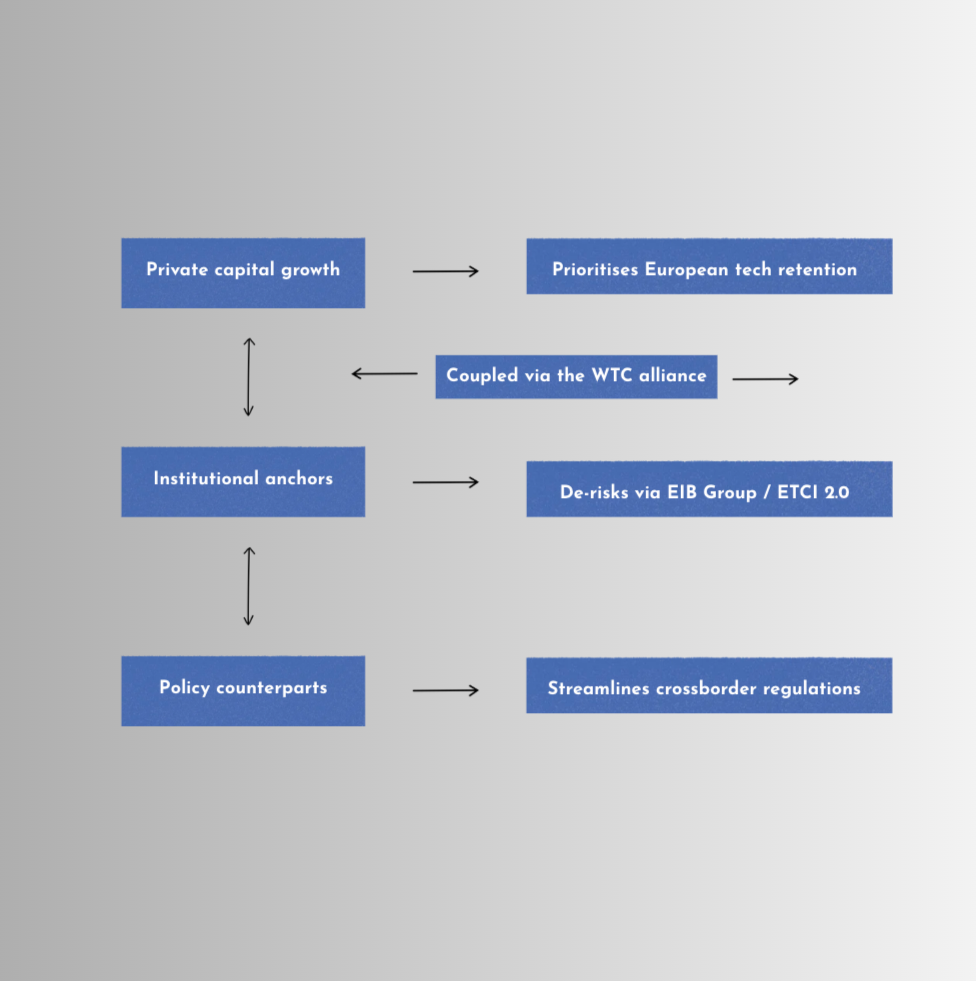
The EU Sovereign Capital Alliance extends this capability into the capital markets, bringing three vital pillars to a single table:
-
Commercially minded European and international asset managers ready to prioritise European scale-ups, provided the risk-adjusted return profile is competitive.
-
The EIB Group, national promotional banks, and sovereign-adjacent vehicles capable of deploying de-risking mechanisms, building on successful frameworks like the expanded ETCI 2.0 under the TechEU platform.
-
Leadership from the E6 ministerial tier and the European Commission, which hold the structural levers to fast-track regulatory approvals and harmonise cross-border capital deployment.

The White Knight Pledge →
The core engine of this Alliance is a market-driven, conditional commitment framework: The "White Knight" Pledge. If policymakers deploy the right de-risking instruments at the late-stage growth level, participating private funds pledge to step in as preferred capital partners. This ensures Europe's frontier champions are supported at the critical Series B, C, and pre-IPO windows where capital flight to foreign markets traditionally occurs.
This pledge is entirely market-led and respects global liquidity mandates. It is not a capital control, nor is it a restriction on where a company may ultimately list or expand. It is an organised "Right of First Coordination"- ensuring an Estonian quantum developer or a Portuguese defence AI firm has a competitive domestic funding alternative before non-EU acquisition becomes the only path forward.
Three operational drivers make this pledge highly actionable:
-
Utilising EIB and EIF co-investment tranches to narrow the risk premium that often makes European mid-market tech deals less competitive than US equivalents.
-
Deploying MISP-enabled cross-border fund structures and fast-tracked ESMA clarity to eliminate the localised red tape that slows down private capital allocation.
-
A shared, confidential registry of upcoming frontier tech scale-ups approaching late-stage rounds, giving European investors the necessary lead time to organise competitive bids.
Filling the Connective Gap
Macro-level frameworks like the Savings and Investments Union (SIU) establish the rules, and instrument-level breakthroughs such as the newly unveiled €5 Billion Scaleup Europe Fund managed by EQT provide targeted capital injections.
The EU Sovereign Capital Alliance operates dynamically in the space between them: the exact moment a specific company in a specific frontier sector needs an agile, well-supported European investor to anchor their next phase of growth. As an independent, non-governmental convening platform, WTC is uniquely positioned to secure this trust, giving private capital commercial autonomy while aligning fully with Europe's broader economic resilience.
The Pan-European Orbit
While the E6 acts as the initial regulatory and capital engine due to its combined economic weight, the true vision of the E6 Concord is inherently pan-European. Industrial sovereignty cannot be achieved in isolation; it requires a seamlessly integrated ecosystem where breakthrough innovations from every corner of the continent can scale without friction.
For frontier tech SMEs operating in the wider European orbit from the digital hubs of Ireland and Estonia to the financial ecosystems of Luxembourg and the growing tech sectors of Portugal and the Baltics, the E6 initiative offers three distinct structural advantages:
-
A unified Savings and Investments Union driven by the E6 means capital no longer stays siloed within national borders. A "White Knight" fund anchored in Frankfurt or Paris will have a mandate to back a high-growth Quantum or AI startup in Dublin or Lisbon, preventing capital flight to the US.
-
By harmonizing cross-border regulations and tech supervision packages among Europe’s six largest economies, the E6 creates a massive, standardized marketplace. If an SME in Luxembourg complies with the new sovereign standards, they instantly unlock access to 70% of the EU consumer and enterprise market without navigating six different sets of local red tape.
-
Smaller, highly specialized tech ecosystems are often the most vulnerable to global supply chain shocks. The E6’s focus on raw materials security, domestic cloud infrastructure, and advanced semiconductor pipelines provides a robust, defensive shield that protects and stabilizes mid-market operators across the entire union.
Conclusion
True economic and industrial sovereignty cannot be handed down through decree; it must be co-authored by the builders shaping the frontier industry. If the voice of frontier technology SMEs is absent from these rooms, the resulting frameworks will skew toward legacy industries and bureaucratic box-checking.
The World Technology Congress is providing that bridge. By architecting a Europe-wide SME survey through the Frontier Tech Sovereignty study, with a sharp focus on helping transform individual SME operational challenges into collective continental leverage. We are aggregating the economic footprint of 3,000+ elite mid-market companies to present an unassailable data-driven mandate directly to the European institutions and E6 finance ministries.
Sources
E6 Finance Ministers (Roland Lescure, Lars Klingbeil, Giancarlo Giorgetti, Eelco Heinen, Andrzej Domański, Carlos Cuerpo), Market Integration and Supervision Package (MISP): Input for Council Negotiations by France, Germany, Italy, the Netherlands, Poland and Spain, 28–29 May 2026. Bundesfinanzministerium. bundesfinanzministerium.deFreshfields, Europe's Largest Economies Push to Shape the Future of Capital Markets: The E6 Joint Position on MISP, 29 May 2026. freshfields.comEuropean Commission, Directorate-General for Financial Stability, Financial Services and Capital Markets Union, Market Integration and Supervision Package, 4 December 2025. finance.ec.europa.euValue The Markets, E6 Finance Ministers Push for Action on EU Capital Markets Integration, 28 May 2026. valuethemarkets.comEIB Group / European Investment Fund, EIB Group Supports the Pan-European Scale-Up Initiative to Promote Tech Champions, 9 February 2022.The State of European Deep Tech in 2026: Funding, Policy, and Ecosystem, deeptech.build, June 2026.Jason Rainbow, U.S. Investors Dominate Europe's Private-Led Space Scale-Up Rounds, SpaceNews, 30 April / 20 May 2026.EIB Group, The Scale-Up Gap: Financial Market Constraints Holding Back Innovative Firms in the European Union, July 2025. eib.orgEuropean Commission R&I, EU Startup and Scaleup Strategy Drivers of Relocation by Innovative EU Startups and Scaleups, January 2026; Strategy update 29 May 2026.